

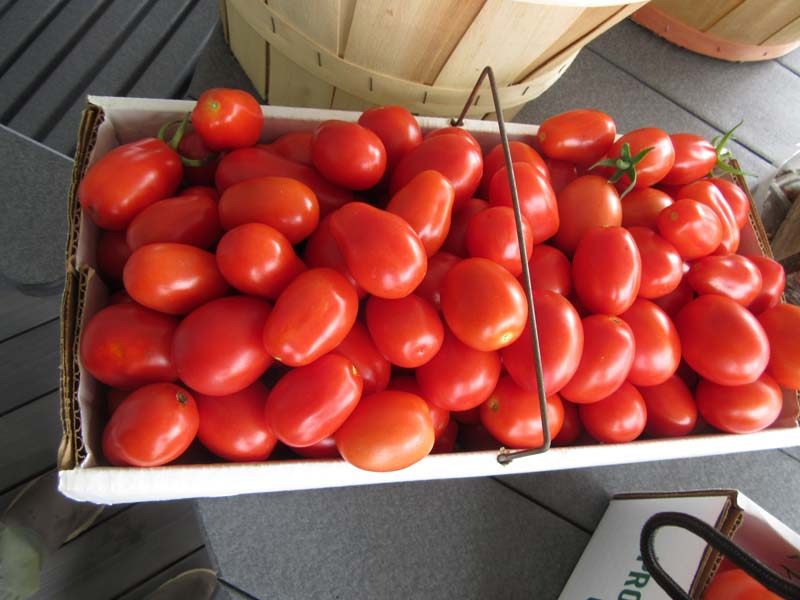
I love tomatoes. Since I started making my own pasta sauce, I have not bought any store bought sauce for a long time. I am still learning what makes the best sauce, but think I have settled on what I consider the best. The first sauce I made was from VF Romas, a hybrid tomato (more on that later). At that time, I didn’t even know the difference between determinate and indeterminate tomatoes. I wondered why my VF Roma plants were so short. I learned that, simply put, determinate are bush type and indeterminate are vining. At any rate, I got 70 lbs of tomatoes off 5 plants and started my sauce making venture. I canned 54 pints that year, and the sauce was good, but could I do better?
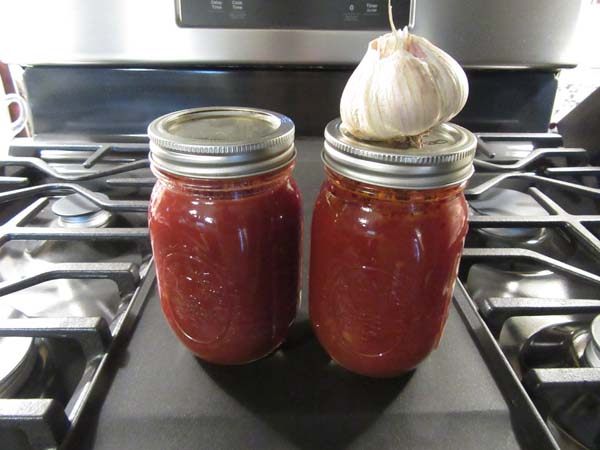
The following year, I decided to try growing the standard for tomato sauce, San Marzano, which is an heirloom variety. They are indeterminate tomatoes. That year my tomato plants were over 6 feet tall, and I got about 60 lbs of tomatoes off 6 plants and made sauce once again, to the tune of about 48 pints. My pressure canner holds 18 pints, so it was 3 batches. The sauce was better tasting in my opinion (using the same recipe as I used for the VF Romas), but I was still striving for that perfect sauce tomato.
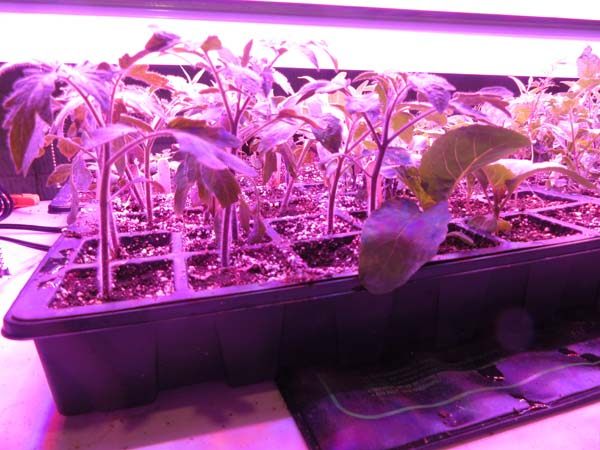
In 2023, I started more VF Romas in my basement under lights, as I always do. The plants were doing well, just waiting for my May plant date after the last frost. I planted them May 17th, taking a big risk of a frost. I woke up May 18th to a hard frost. All of my tomatoes, cukes, and melons were killed. I knew I could restart the cukes and melons from seed and still get a crop, but it was too late to plant tomatoes from seed. I was forced to go to a nursery to buy tomato plants.
That frost turned out to be the best thing that could have happened to me. I bought Amish Paste tomato plants at the nursery, and I have finally found my perfect tomato for making sauce. I knew the minute I tasted the tomatoes that I had a winner. They are good for fresh eating as well as making sauce. Keep in mind that I use the same recipe every year. The sauce from the Amish Paste tomatoes turned out to be the best sauce I have ever eaten. I will be using only Amish Paste from here on out. They are also an heirloom, which means I can keep the seeds and replant each year.
The Recipe
This recipe is adapted from Favorite Family Recipes: Canned Spaghetti Sauce. It makes 9 quarts or 18 pints (I use pints because there are only two of us).
- 25 lbs Amish Paste tomatoes
- 5 medium onions (about 7–8 cups chopped)
- 4 red bell peppers (chopped)
- 1 green bell pepper (chopped)
- 4 (6 oz) cans tomato paste
- ¼ cup soy sauce
- 3 Tbsp Worcestershire sauce
- 2/3 cup brown sugar
- ¼ cup salt
- 20 cloves garlic (chopped or minced)
- 3 Tbsp dried oregano (I tried fresh, but think dried is better)
- 3 Tbsp dried basil (I tried fresh, but think dried is better)
- 2 tsp red pepper flakes
- 2 bay leaves
- 1 Tbsp lemon juice for each jar
If you don’t have a tomato mill
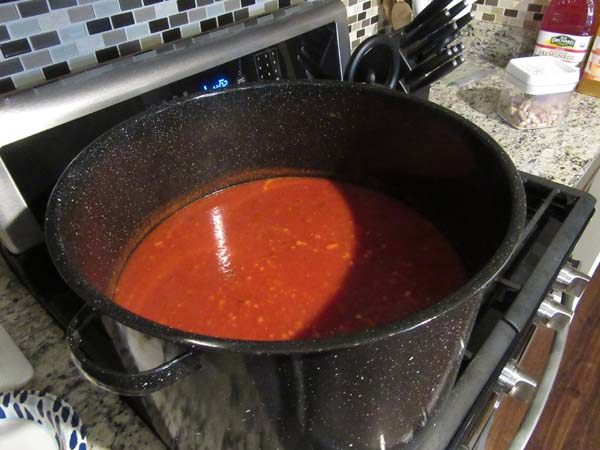
Start by carefully putting the tomatoes in a pot of boiling water for 1 to 2 minutes. Then, with a slotted spoon, lift them out, put them in a bath of ice water, and peel; this makes the skins come off easily. Then quarter and process them in a food processor or blender in batches, and pour the sauce into a large stockpot. Then I just put in all the ingredients and cook on low to medium heat for 5 hours, making sure to stir every 15 minutes so the sauce doesn’t burn on the bottom of the pot. Discard the bay leaves at the end of the cook.
I prefer a tomato mill. It is far easier, and makes a better sauce in my opinion. The one I use is the Fabio Leonardi SP3.
Canning the sauce
I clean my jars and lids in the dishwasher. If you are pressure canning, there is no need to boil the lids. Put 1 Tbsp of lemon juice in each jar (2 Tbsp for quarts) and ladle the sauce into each jar using a canning funnel until it is filled to 1/2 inch headspace at the top. I use a bamboo skewer to run around the inside of the jar to bring any air bubbles to the top. Then wipe the rim of each jar, put the lid on, and gently screw on the band. I have learned that if you press down with one finger on the top of the lid while you are tightening, you should tighten until the jar starts to rotate. If they are tightened too much, the jars can break while processing.
Water bath canning
Process for 40 minutes in a boiling-water canner for altitudes of 1,000 feet or less. For altitudes up to 3,000 feet, add 5 minutes; 6,000 feet, add 10 minutes; 8,000 feet, add 15 minutes; 10,000 feet, add 20 minutes.
Pressure canning
Using a weighted-gauge pressure canner, process 20 minutes for pint jars and 25 minutes for quart jars. Process at 10 lb for altitudes between 0–1,000 feet. Process at 15 lb for altitudes above 1,000 feet.
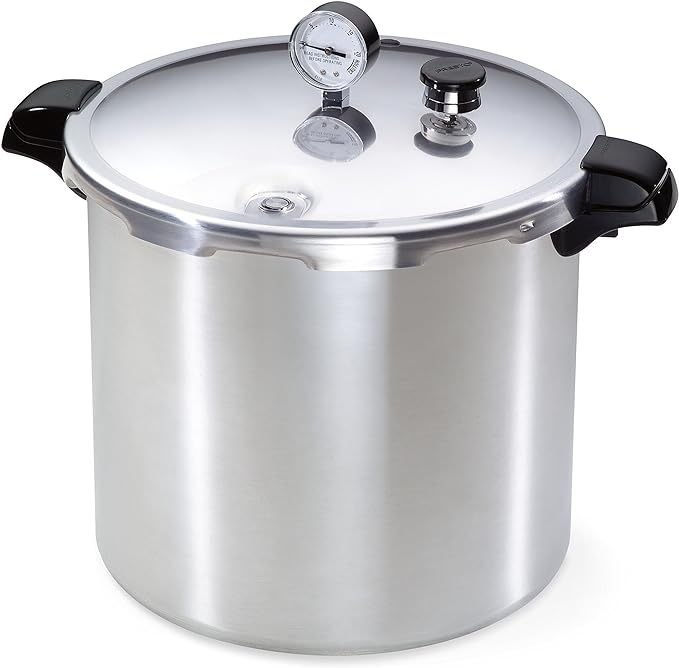
I prefer pressure canning and have a Presto 23 Quart Pressure Canner. If you search for “Presto Precise Gauge Pressure Canner and Cooker, 23 qt,” many places carry it.
Enjoy!