Saving Seeds: Saving Your Garden’s Legacy

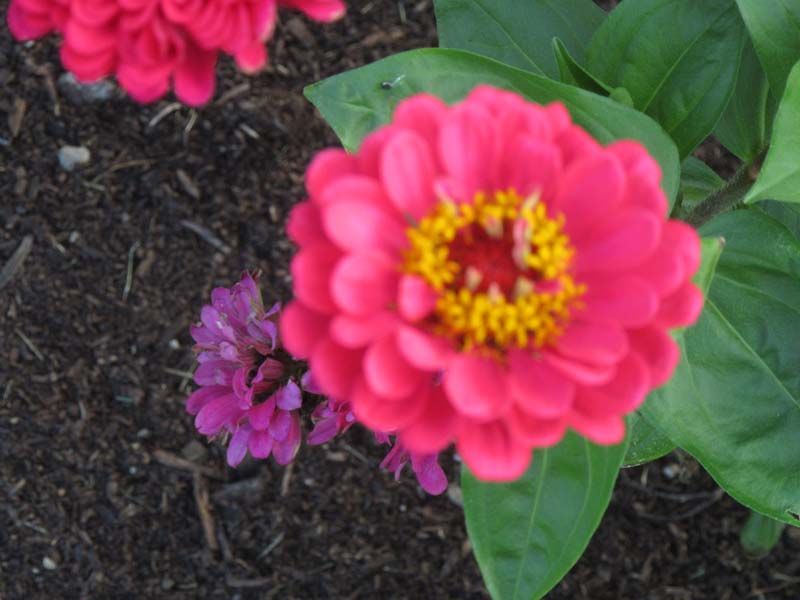
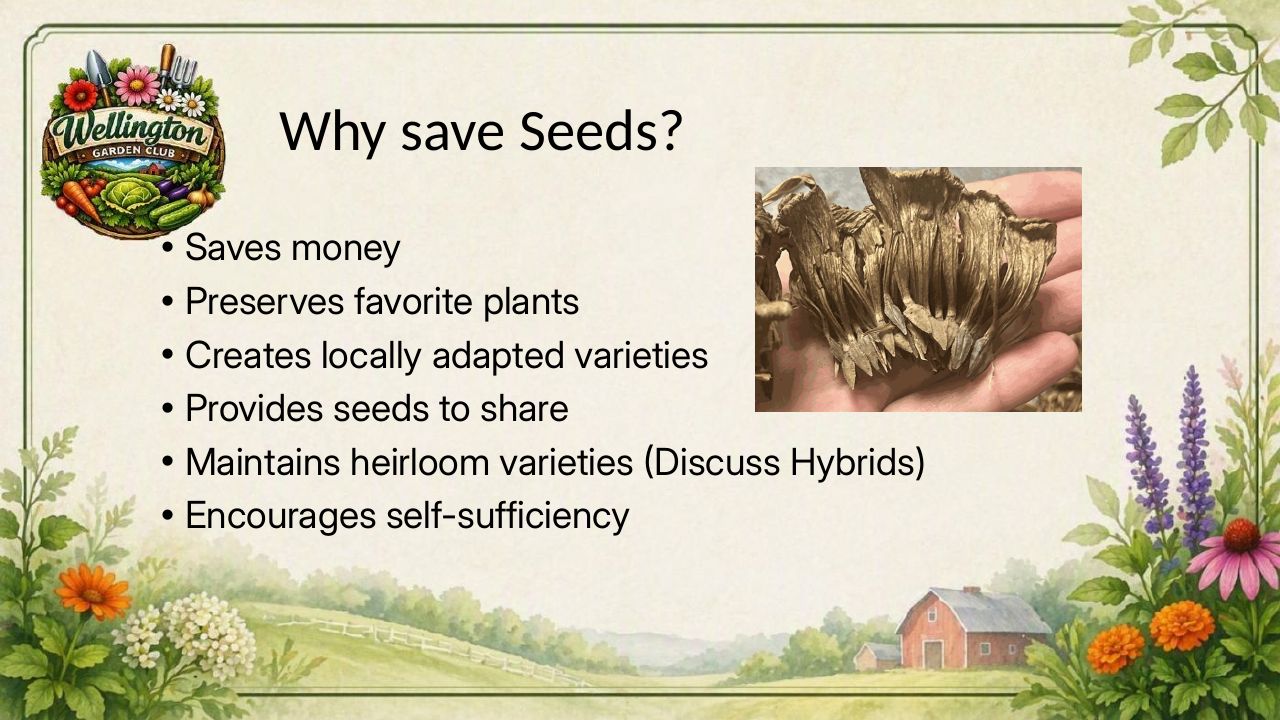
Flowers grown by a Wellington Garden Club member

Presented at the November 17, 2026 meeting: how saving seed from your best plants saves money, preserves favorites and builds varieties suited to our local conditions.
Saving Seeds slide 1
Saving Seeds slide 1Saving Seeds slide 2Saving Seeds slide 3Saving Seeds slide 4Saving Seeds slide 5Saving Seeds slide 6Saving Seeds slide 7Saving Seeds slide 8Saving Seeds slide 9

Key points

  • Saving seed from your best performers year after year creates plants adapted to your own soil and weather.
  • Open-pollinated and heirloom varieties come true from seed; hybrids generally do not.
  • The five rules: start with easy plants, harvest only mature seed, dry thoroughly, label everything, and store cool, dry and dark.
  • Dry collection works for flowers like zinnias, cosmos and marigolds; wet collection (with a short ferment) works for tomatoes and cucumbers.
  • Store seeds in a sealed, labeled jar in the refrigerator, and run a simple germination test on older seed.
Read all the slides as text

Slide 1: Saving Your Garden’s Legacy

Saving your Seeds

Wellington Garden Club Meeting

Tuesday, Nov. 17th, 2026

Slide 2: Why save Seeds?

Saves money

Preserves favorite plants

Creates locally adapted varieties

Provides seeds to share

Maintains heirloom varieties (Discuss Hybrids)

Encourages self-sufficiency

Slide 3: Creates locally adapted varieties

What it means

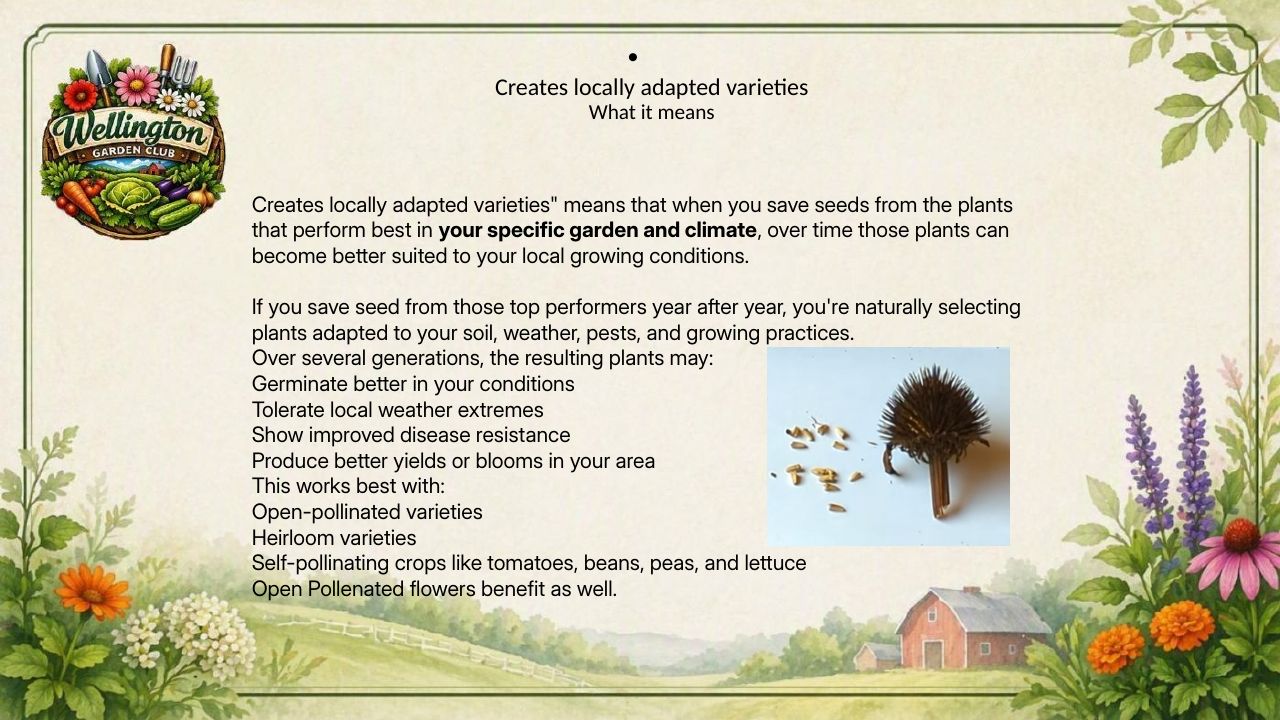
Creates locally adapted varieties" means that when you save seeds from the plants that perform best in your specific garden and climate, over time those plants can become better suited to your local growing conditions.

If you save seed from those top performers year after year, you're naturally selecting plants adapted to your soil, weather, pests, and growing practices.

Over several generations, the resulting plants may:

Germinate better in your conditions

Tolerate local weather extremes

Show improved disease resistance

Produce better yields or blooms in your area

This works best with:

Open-pollinated varieties

Heirloom varieties

Self-pollinating crops like tomatoes, beans, peas, and lettuce

Open Pollenated flowers benefit as well.

Slide 4: "The Five Rules of Seed Saving"

Start with easy plants.

Harvest only mature seeds.

Dry seeds thoroughly.

Label everything.

Store cool, dry, and dark.

Slide 5: What Is Open-Pollination?

Open pollination describes plants that have been pollinated naturally, either by cross-pollination or self-pollination. Cross-pollination methods include pollination by wind, water, or pollinators like bees or other insects. In self-pollination, a plant has both female and male parts and can pollinate itself. Open-pollinated seeds, also called “true to type” or “true to seed,” are a result of the natural pollination of two plants of the same variety. When planted, open-pollinated seeds should have the same characteristics as the parent plant. This is in contrast to hybrid seeds, which are the result of manually pollinating two different varieties to achieve a new variety with characteristics from both.

Slide 6: Knowing when seeds are ready

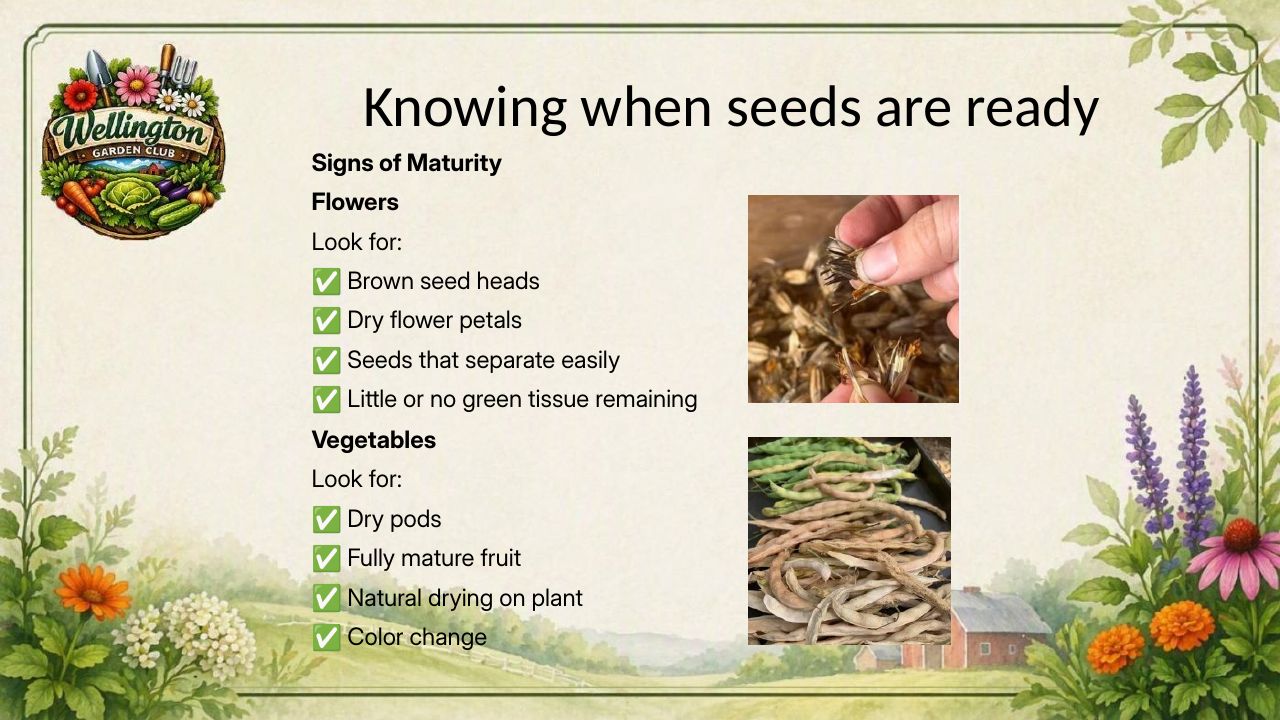
Signs of Maturity

Flowers

Look for:

✅ Brown seed heads

✅ Dry flower petals

✅ Seeds that separate easily

✅ Little or no green tissue remaining

Vegetables

Look for:

✅ Dry pods

✅ Fully mature fruit

✅ Natural drying on plant

✅ Color change

Slide 7: Collection Methods

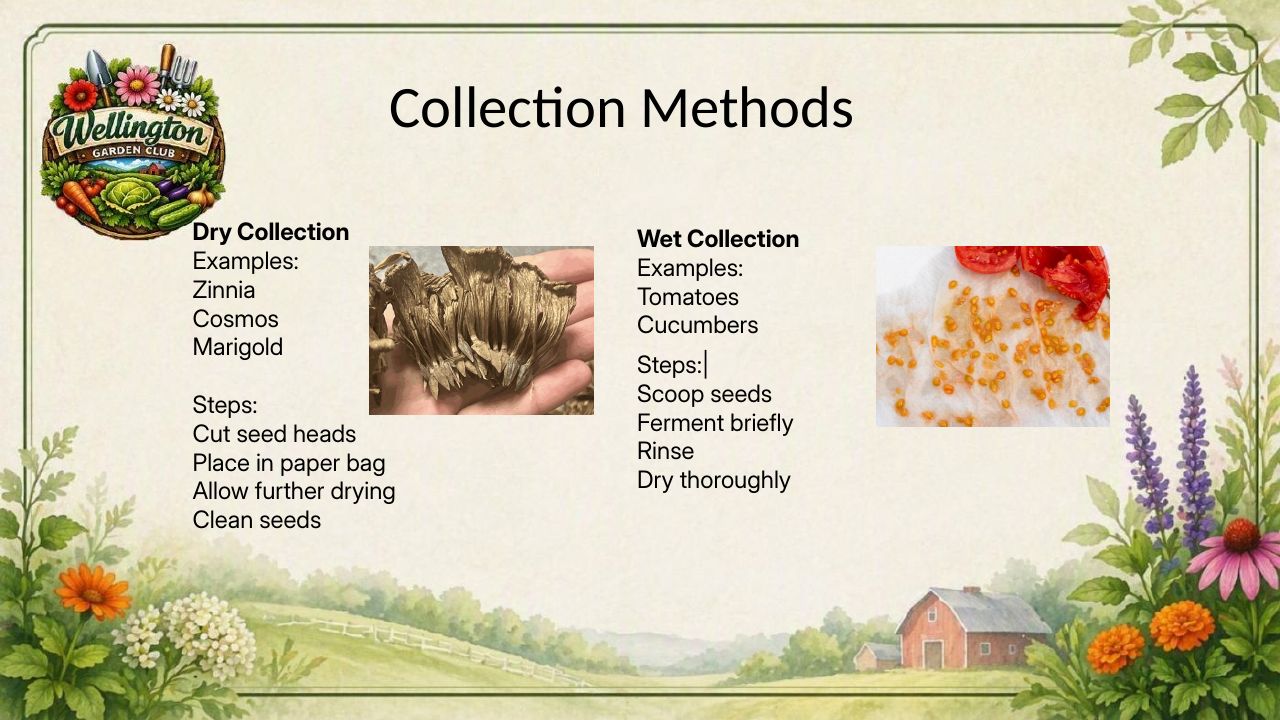
Dry Collection

Examples:

Zinnia

Cosmos

Marigold

Steps:

Cut seed heads

Place in paper bag

Allow further drying

Clean seeds

Wet Collection

Examples:

Tomatoes

Cucumbers

Steps:

Scoop seeds

Ferment briefly

Rinse

Dry thoroughly

Slide 8: Storage Conditions

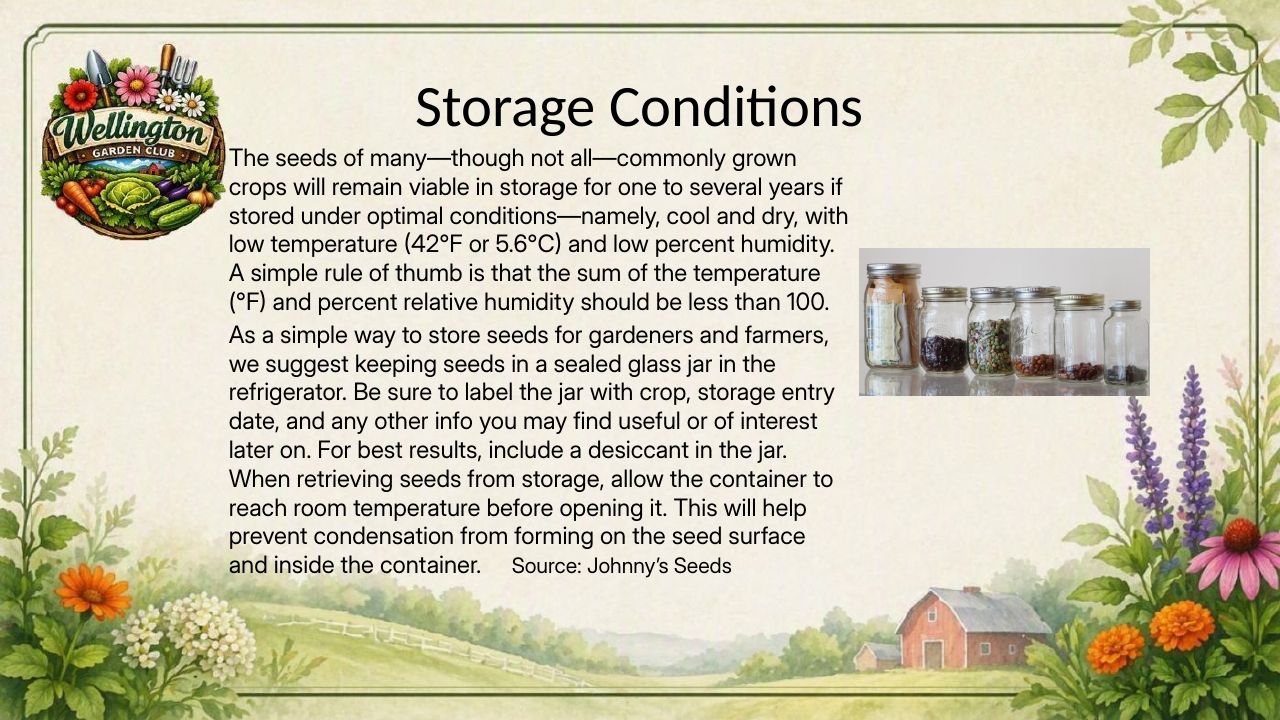
The seeds of many—though not all—commonly grown crops will remain viable in storage for one to several years if stored under optimal conditions—namely, cool and dry, with low temperature (42°F or 5.6°C) and low percent humidity. A simple rule of thumb is that the sum of the temperature (°F) and percent relative humidity should be less than 100.

As a simple way to store seeds for gardeners and farmers, we suggest keeping seeds in a sealed glass jar in the refrigerator. Be sure to label the jar with crop, storage entry date, and any other info you may find useful or of interest later on. For best results, include a desiccant in the jar. When retrieving seeds from storage, allow the container to reach room temperature before opening it. This will help prevent condensation from forming on the seed surface and inside the container. Source: Johnny’s Seeds

Slide 9: Seed Viability Test

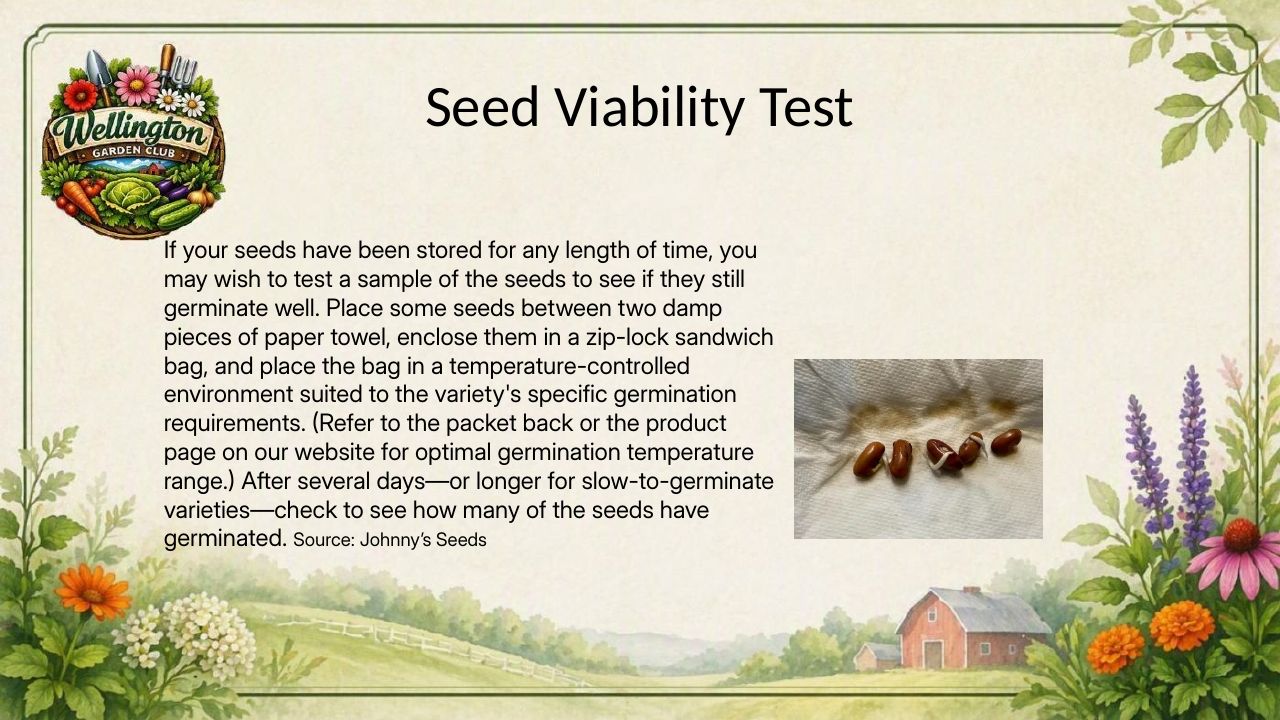
If your seeds have been stored for any length of time, you may wish to test a sample of the seeds to see if they still germinate well. Place some seeds between two damp pieces of paper towel, enclose them in a zip-lock sandwich bag, and place the bag in a temperature-controlled environment suited to the variety's specific germination requirements. (Refer to the packet back or the product page on our website for optimal germination temperature range.) After several days—or longer for slow-to-germinate varieties—check to see how many of the seeds have germinated. Source: Johnny’s Seeds

Download the slides